


 contact@icitech.net
 0356087075


Sales Automation with AI Email Writer: The Future of CRM Systems
 17 April 2026
1. Introduction: The Evolution of CRM from Database to Intelligence
The architectural divide in modern business is no longer just between different software providers, but between two eras of technology: the static database and the intelligent cloud. For decades, high-growth companies relied on legacy systems like the Microsoft 365 MDB (Microsoft Database) framework—a model characterized by local SQL Servers and siloed MIS databases. These systems are inherently fragile, built on outdated code and libraries that demand high maintenance and lack the fluidity of cloud-based access.
At ICI Technology , our mission is to lead high-growth SMEs through this transition, helping them slash IT and software expenditures by up to 75% while simultaneously boosting customer retention. By moving away from static, on-premise dependencies, we implement "Smart CRMs" where AI Email Writers and automated Sales Cadences aren’t just features—they are the new standard for operational excellence.
2. The Power of AI Email Writers in Sales Automation
In a modern CRM architecture, language models (LLMs) act as a cognitive layer over the "Sales" and "Client Management" modules. Rather than simply storing data, the system actively interprets it. The technical foundation for this automation rests on "Sales Notes" and "Client Information" tabs, which contain granular data ranging from address history to specific contract terms.
An AI Email Writer leverages this context to generate personalized outreach. By analyzing previous interactions and contact list history, the AI drafts messages that reflect specific client nuances.
The shift from manual entry to AI-assisted drafting represents a paradigm shift: sales teams are liberated from administrative data entry, moving instead toward strategic relationship management where real-time client notes inform every automated communication.
3. Mastering Sales Cadences: Data-Driven Follow-Ups
Effective sales automation is defined by its triggers. By synthesizing "Schedule/Project Entry Management" with "Task Management," a Smart CRM creates automated Sales Cadences that respond to real-world milestones. Unlike legacy systems that require manual reminders, an AI-driven system uses specific logic triggers such as "Start/End Dates," "Pull Dates," and "Show Dates" found in the project information.
For a "Sales" user profile, managing these reminders becomes an exception-based task rather than a daily grind. A typical AI-driven cadence operates as follows:
Data Analysis: The system scans Client and Project notes, identifying upcoming "Pull Dates" or "Show Dates" that require confirmation.
Data Analysis: The system scans client and project notes, identifying upcoming "Pull Dates" or "Show Dates" that need confirmation.
Personalized Drafting: The AI email writer creates a tailored follow-up based on the project's specific terms or "Load-in/Out" history.
Automated Scheduling: The message is queued through the Agenda/Schedule screen logic, ensuring delivery at the exact moment it will have the greatest impact.Personalized Drafting: The AI Email Writer generates a tailored follow-up based on the project's specific terms or "Load-in/Out" history.
Automated Scheduling: The message is queued via the Agenda/Schedule screen logic, ensuring delivery at the precise moment to maximize impact.
4. Implementation Spotlight: Restoration Industry and Data Personalization
In the restoration industry—a sector where response speed is the primary driver of ROI—AI automation is transformative. In this context, the AI analyzes "Inventory Management" data, including Unit Price, Weight, and Dimensions, to provide immediate, actionable value.
Expert-level AI integration goes beyond simple text; it performs complex synthesis. By analyzing the "Materials" extra properties within the inventory (e.g., calculating that a 4x8ft sheet equals 32sqft), the AI doesn't just draft an email—it calculates a precise, automated project quote. It factor in the logistics footprint based on equipment "Weight" and "Dimensions," automatically including a freight estimate in the sales communication to ensure the customer receives a comprehensive quote within seconds of a lead being generated.
5. Specialized Automation: Collections and Payment Reminders
Automation's greatest impact often occurs in the "Payment Tab." By tracking "Balance Due Dates," "Required Amounts," and "Amount Received," a CRM can automate the entire collections lifecycle. The system's intelligence is tied to the "Status" feature; for instance, if a project is marked as "Billed" and the "Due Date" passes without a "Deposit" or "Balance" update, the system triggers a professional payment reminder.
This level of operational efficiency is more than a convenience—it is a proof point for scalability. As demonstrated in the Phat.AI case study, financial startups have secured $5M Series A rounds by deploying such streamlined, AWS-integrated platforms. Automating the financial back-office proves to investors that a company can scale its volume without a proportional increase in administrative headcount.
6. Technical Foundation: The Cloud-Based CRM Architecture
To enable AI Email Writers to perform real-time data retrieval, the underlying infrastructure must move from siloed MDB files to a centralized AWS environment. A centralized AWS RDS (PostgreSQL) is the critical component here, allowing for the vector searches and high-speed data access that modern AI requires.
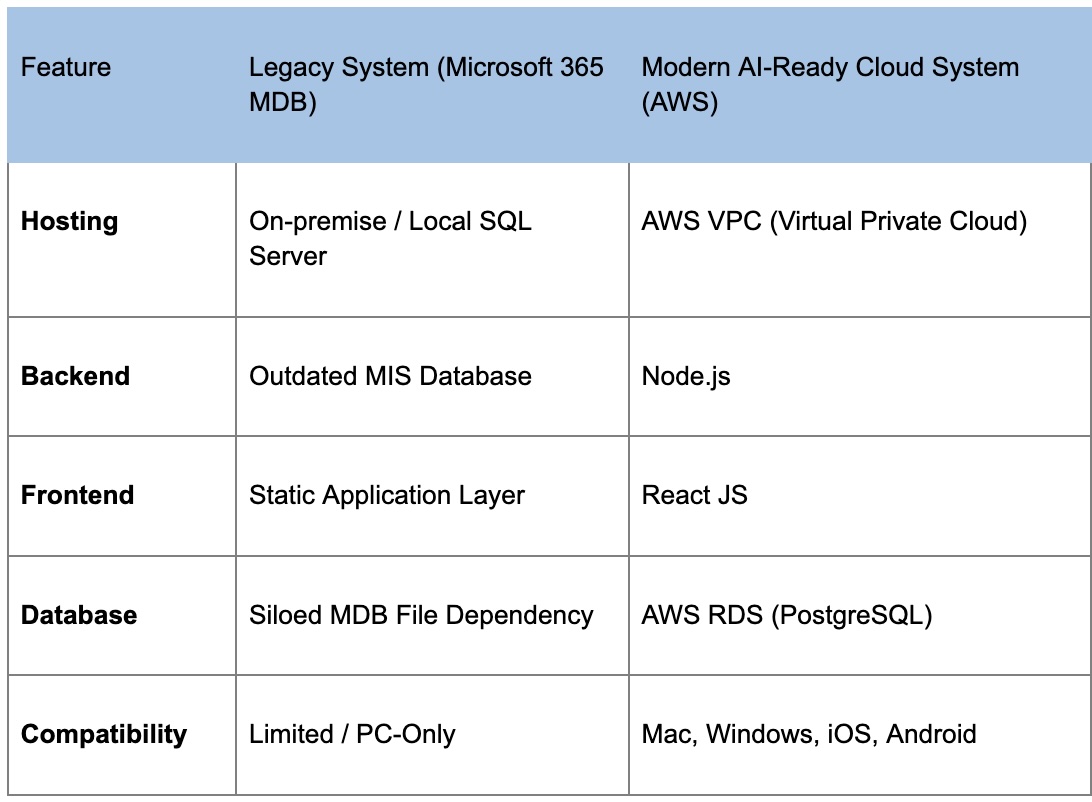
The use of a Virtual Private Cloud (VPC) provides the necessary security layer for handling sensitive financial data within the "Payment Tab," ensuring that while the AI has access to the data it needs, the business remains compliant and secure.
7. Macro Features for High-Growth Scalability
The scalability of the system is anchored by its "Macro Features," which govern how the AI interacts with the business's physical and human assets:
Inventory Management: The system distinguishes between Standard Items (individually numbered), X-items (non-numbered collections/bulk items), and Z-items (packaged items). This distinction allows the AI to calculate availability and logistics accurately.
Task Management: Tasks are assigned to specific members with "Done" or "Cancelled" statuses. A task marked "Cancelled" can automatically trigger a different AI branch in the sales cadence, such as a "Win-Back" email sequence.
User Management: Roles (Admin, Sales, Worker, Crew Member) define the permissions and the scope of data the AI can access when drafting communications.
8. Conclusion: Strategic Advantages for Small and Medium Businesses
The transition from outdated, on-premise code to a unified, AWS-hosted backend is a strategic imperative. For high-growth businesses, the competitive edge is found in the "Smart CRM"—a system that understands project milestones, inventory logistics, and financial statuses.
By implementing AI Email Writers and automated Sales Cadences, companies can significantly boost customer retention through timely, personalized, and professional communication. ICI Technology remains committed to this future: slashing software expenditure by 75% while providing the technical intelligence necessary to scale in a digital-first economy.







Tại sao
Lorem ipsum dolor sit amet consectetur, adipisicing elit. Officiis, vero voluptatibus tenetur incidunt debitis numquam aut qui,...
Đây là comment của Hacker2
Hello
alo
A
ádfasdf